Literacy has never been simply about whether a student can read the words on a page. We see literacy at work when learners make meaning, communicate ideas, solve problems, ask questions, and use what they know to participate in the world around them. What has changed is the world in which students are being asked to do these things.
Today, a learner may begin with a printed text, follow a hyperlink, watch a video, encounter a social media post, and consult an artificial intelligence (AI) tool; all within the same learning experience. This raises an important question for educators: Are we preparing students simply to access more information, or are we preparing them to think critically about the information they encounter?
The UNESCO Institute for Statistics (UIS, n.d.) defines literacy as:
Literacy is the ability to identify, understand, interpret, create, communicate and compute, using printed and written materials associated with varying contexts. Literacy involves a continuum of learning in enabling individuals to achieve their goals, to develop their knowledge and potential, and to participate fully in their community and wider society. (para. 1)
The idea of a literacy continuum of learning matters. Literacy is not a destination students either reach or fail to reach. Learners develop at different rates and require different combinations of instruction, support, challenge, and opportunity along the way.
Digital literacy does not replace foundational literacy; it builds upon it. Decoding, fluency, vocabulary, comprehension, spelling, and written expression remain essential. What has changed is the complexity of the environment in which students apply these skills. Mo (2019) explains that contemporary reading includes electronic formats and requires readers to navigate multiple sources and distinguish fact from opinion. Finding information is increasingly easy. Knowing what to trust, what to question, and what to do with that information is considerably harder. More than ever, students need to use evaluative comprehension as they engage with texts presented across various formats and platforms.
Regardless of their literacy levels, all students need opportunities to develop the skills required to navigate text and technology. They must learn to comprehend information, evaluate credibility, distinguish fact from opinion, compare sources, identify evidence, communicate ideas, and make responsible use of digital tools.
These demands become even more important with generative AI. Students can produce an answer in seconds, but speed should never be confused with understanding. UNESCO (n.d.) emphasizes the importance of media and information literacy for critically engaging with information and navigating contemporary information environments. Students need to ask: Who created this information? What evidence supports it? Is the source credible? What might be missing? Can I verify it elsewhere?
AI adds another question: Should I trust what this tool has produced? Students need to verify AI-generated claims, compare information across sources, recognize inaccuracies, preserve their own thinking and voice, and use technology ethically. AI literacy is therefore another context in which critical literacy must be applied.
Schools can adopt a Multi-Tiered System of Supports (MTSS) as a framework for responding to individual learner needs, rather than viewing it primarily as a structure for intervention. The
MTSS Diamond Model presented by the National Association of Special Education Teachers (NASET, 2025) illustrates this broader view. Effective, differentiated core instruction remains at the center, while targeted and intensive intervention provide scaffolds on one side and targeted extension and intensive enrichment provide greater challenge on the other.
Within this framework, assessment and progress monitoring help educators identify the intervention or extension skills individual learners need. However, literacy level should not determine whether a student has access to the essential skills needed to navigate text, information, technology, and AI. What changes is the scaffolding, intensity, complexity, and pace of instruction, not the expectation that every learner develops these competencies.
A student receiving explicit decoding or fluency intervention can simultaneously engage with rich, grade-level ideas through audio, visuals, digital text, and other appropriate scaffolds. A learner ready for extension might investigate competing sources, analyze bias, synthesize complex information, or critically evaluate AI-generated content. MTSS therefore encourages two complementary questions: What does this learner need next? And what must every learner have the opportunity to know and do?
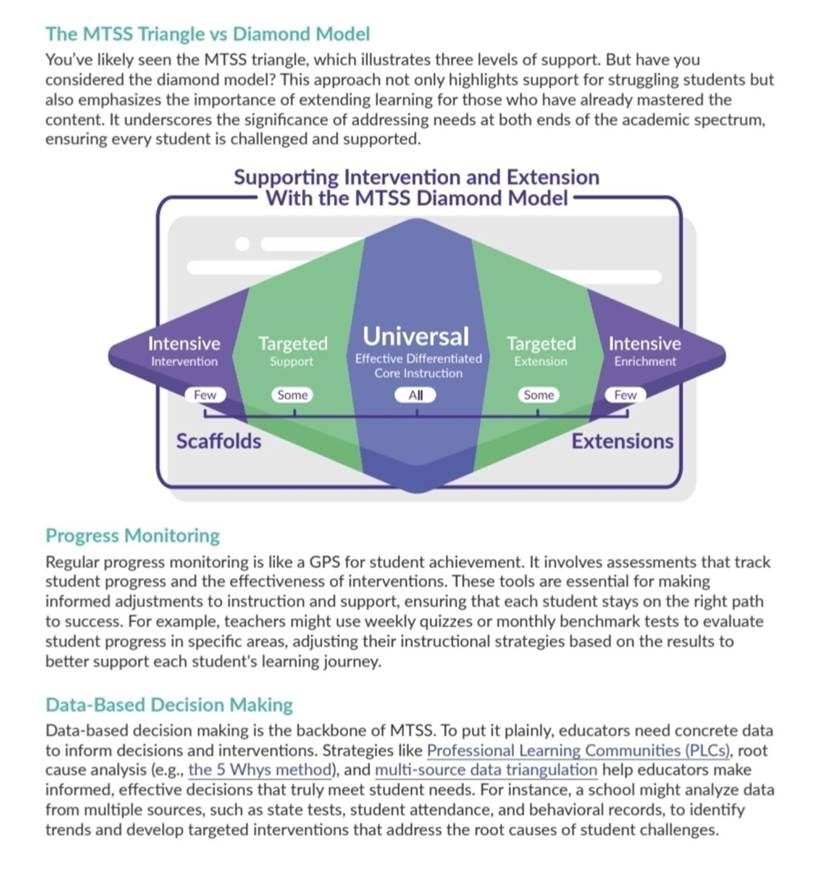
Note. From MTSS Diamond Model Cheatsheet, by National Association of Special Education Teachers,
2025, NASET Support Squad.
The technologies our students encounter will continue to change. We cannot prepare them for every platform or tool, nor do we need to. We can prepare them with literacy habits that travel with them: reading closely, making meaning, asking questions, evaluating evidence, communicating clearly, recognizing when information does not make sense, and knowing where to look next.
MTSS gives schools a framework for varying support and challenge without limiting access to these essential skills. The pathway may differ from learner to learner, but the opportunity to become a capable, critical, and thoughtful reader belongs to every student. Ultimately, literacy in the digital age is about holding onto what matters while responding thoughtfully to what is changing. Our responsibility is to prepare students not only to read the word, but to question, interpret, and read the world in whatever form that world takes next.
Mo, J. (2019). How does PISA define and measure reading literacy? PISA in Focus, 101. OECD
Publishing. https://doi.org/10.1787/efc4d0fe-en
National Association of Special Education Teachers. (2025). MTSS diamond model cheatsheet. NASET Support Squad. https://www.naset.com/professional-resources/naset-supportsquad/
UNESCO. (n.d.). Media and information literacy. https://www.unesco.org/en/media-information-literacy
UNESCO Institute for Statistics. (n.d.). Literacy. UIS glossary.